


Someone said “20 mile march” to me this week, and I started squirming.
It’s a good idea. Jim Collins writes about it in Great by Choice: clear, steady progress, every day. Nothing wrong with it.
It was also our executive’s favorite book during my third year in the role. Every week. “20 mile march” this and “20 mile march” that.
It’s the big spinning wheel on The Price Is Right. What’s our theme this year? Give it a spin, pick one. The list of options runs a mile long. I’ve watched executives land on:
Radical Candor
10X Is Easier Than 2X
Know What You’re FOR
Gratitude
The Energy Bus
These come from books, keynotes, TED talks. On their own, every one of them holds up. A few are on my list of favorites. The problem is expecting one idea to be the pill that fixes everything. Culture asks for more than a one trick pony.
Roy told me yesterday about a project he ran early in his career, fifteen years before anybody called it employee experience.
The error rate on a key piece of the business was too high, and he had a hunch. So they measured it, then built a campaign around it. Frontline employees, the ones responsible for that piece of the work, got named in the employee newsletter when their numbers were strong. The newsletter was a two-page thing somebody’s assistant laid out in Publisher. A colleague pointed out they should measure success instead of errors, so an 11% error rate became an 89% success rate. Then an executive would call the employee personally and congratulate them.
Three months in, he measured again. 99%.
And he shut the campaign down. Cold. No more measuring, no more recognition.
Three months after that, they measured one more time. Still 99%.
The recognition stopped and the habit stayed. Did people keep thanking each other after the campaign ended? I’d bet they did.
So this stuff works.
Then why did I just spend four paragraphs complaining about the book of the year?
Because the focus isn’t wrong. We need this kind of movement inside our organizations. Gratitude matters. So does pushing toward a bigger vision. And on the days the work turns ugly, keeping your energy up is close to the whole ballgame.
None of it is wrong. It’s just beautiful tile laid on a floor with no joists under it. The tile is what everybody sees. The joists are what keep the tile from cracking. Skip the framing and your gratitude program becomes the flavor of the month.
If you want the tile to hold, build the floor first.
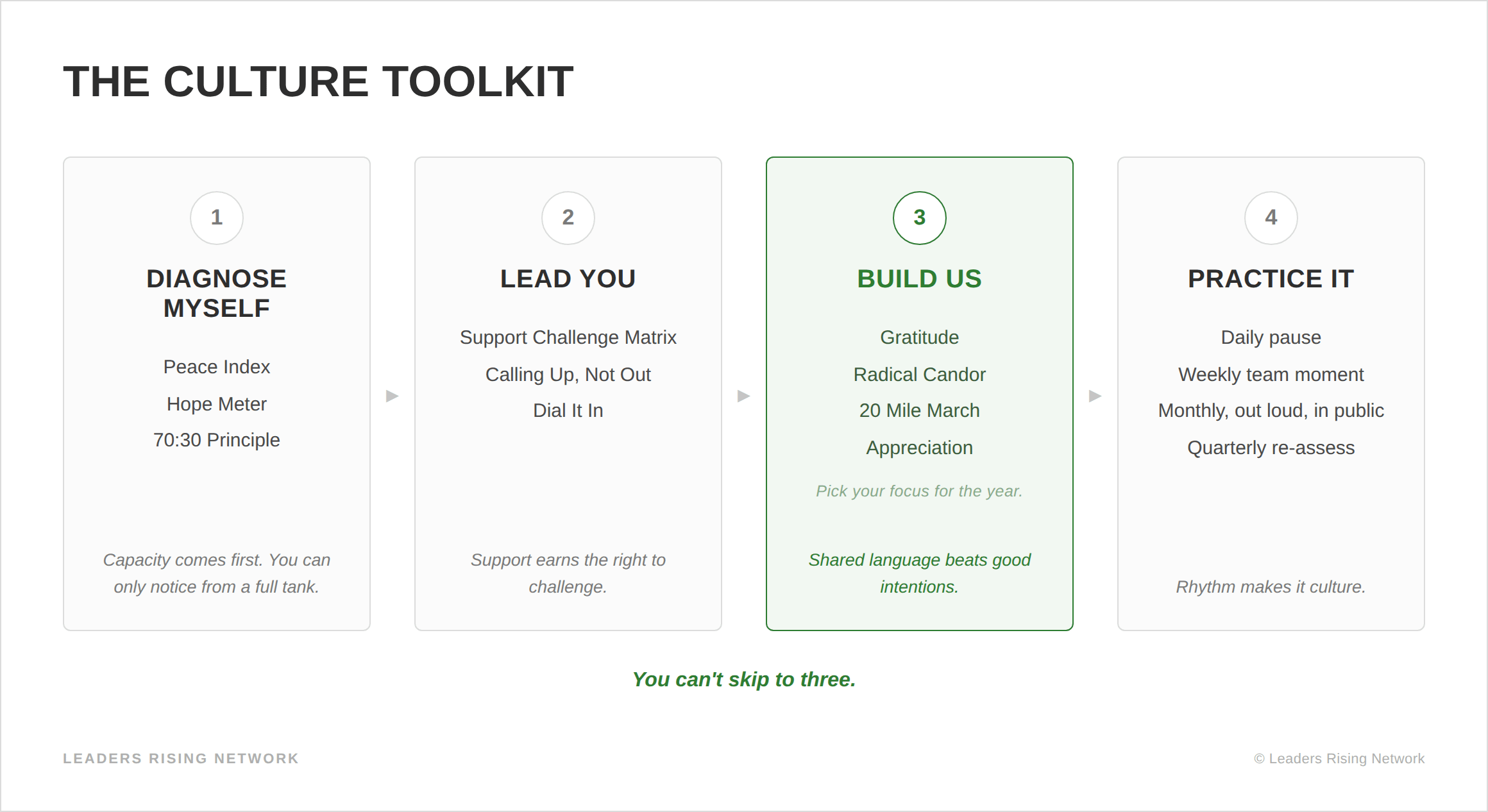
The foundation starts with you.
How are you? Mindset, perspective, well-being, workload. All of it sets the stage for whether you can raise the bar on anybody else’s performance.
Two mornings. Same person, same job.
You argued with your significant other on the way out the door, probably about your mother’s surgery next week. The A/C quit in the hottest week of the year, and your car is sitting at the mechanic’s waiting on an overhaul. There’s a new project starting at work that could make or break the company and your career, and you still haven’t finished the last one. There are never enough hours in the day.
You had a hard conversation with your significant other this morning, and you both walked away confident in the plan. You’re meeting your mother and the doctor later, and you know the doc is one of the best. The HVAC tech caught a problem during your quarterly maintenance and saved you an expensive repair. You’ve got three small details to close out with your team before the new initiative launches, and the team is excited to dive in. You’re all in this together.
Same person, same week, two completely different leaders walk into the building.
How you show up starts with where you’re standing. Being honest about where you actually are, and what you’re actually carrying, is what sets you up.
This is Step 1: Diagnose Myself. You can’t lead anybody else if you aren’t sure where you stand.
Then you can turn to the people around you.
How you handle a hard conversation, how you walk into any meeting, depends on more than your own preparation. What’s on the other person’s plate today? What’s on yours? Who else is in the room, and how are they coming at the problem?
Wanting the best for the person across from you puts you on their side instead of against them. That doesn’t happen just because your head is clear. And it doesn’t happen because you spun the wheel of goodness and landed on a book. It takes deciding, every time, how you’re going to walk into that specific room.
Size up the room and dial it in. Some conversations need more. Some need less. Your ability to tell the difference will do more for your influence than any framework will.
This is Step 2: Lead You.
Once you’ve got a clear head and you can lead the people around you, then you’re ready for Step 3: Build Us.
Step 3 is the wheel. Spin it, pick your focus for the year. Only now there’s a floor under it. You’ve got a common language for how the team works together, and something solid to install the new focus into.
One client launched a gratitude program across the whole organization. Marketing materials, prepared discussions for team meetings and weekly stand-ups, even conversations to have at the daily safety briefing with frontline crews. The momentum was something to watch. Gratitude moves real numbers, especially how people feel about coming to work.
They’re still building it, and I’m watching the signs. The groups with a strong foundation of personal well-being (Step 1) and the ability to have a hard conversation with grace (Step 2) are going to have a very different experience of that gratitude program than the groups without it.
Because if a supervisor thanks you today and chews you out tomorrow, the thank you means nothing. That’s the gap that opens up when nobody laid the floor.
A utility client built a culture guide. Sixteen pages, connecting vision and values to what a person actually does on a Tuesday.
That’s how they get everyone rowing in the same direction. Everybody knows what the values look like in real life, and they know where to look when they need to repair a relationship, fix an interaction, or call a teammate up to a higher standard.
This is Step 4: Practice It. It’s what everyone actually experiences. What do your employees live every day? What do your customers live? How do your suppliers and partners feel after an hour with your company?
Pause here.
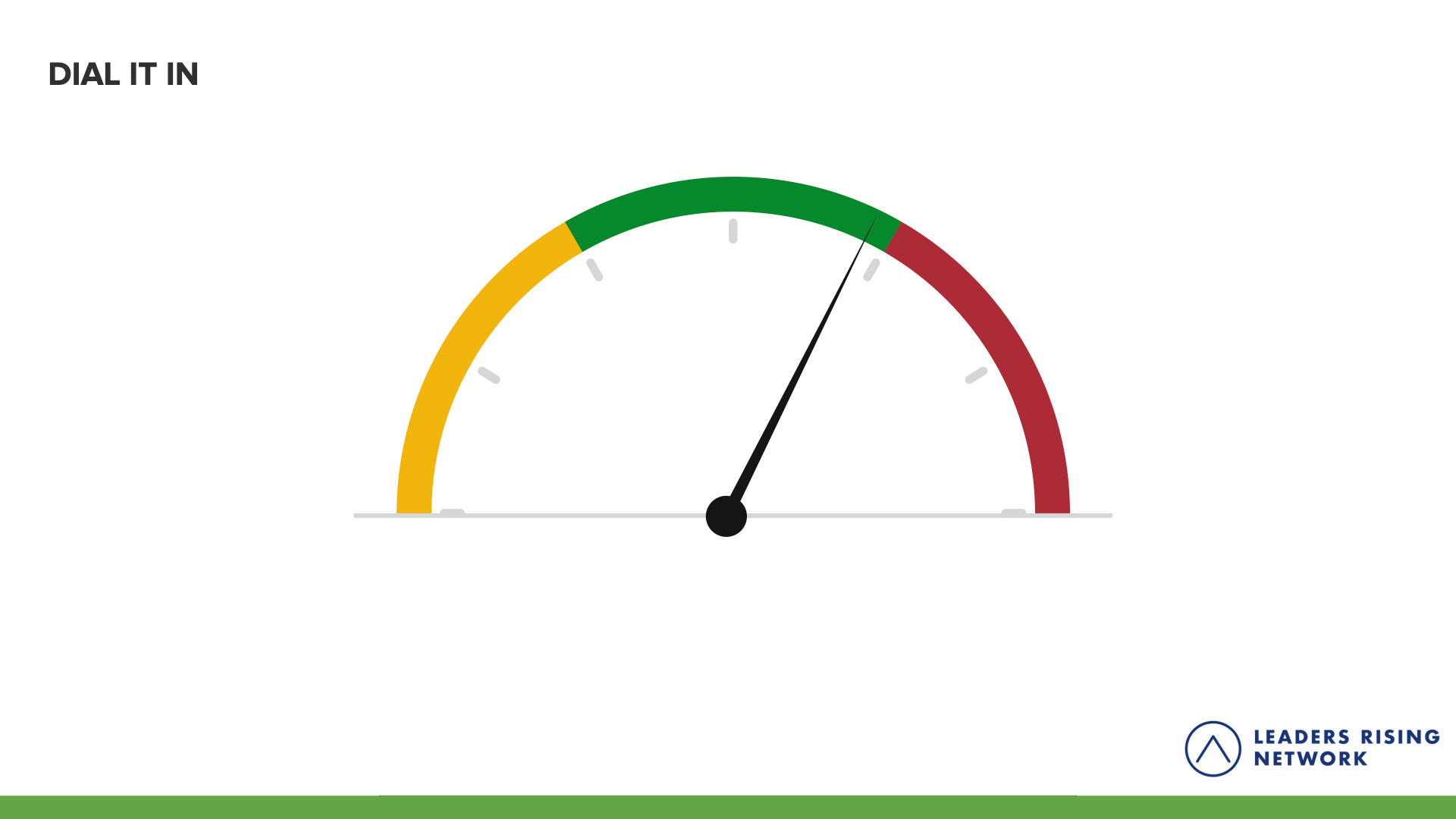
Score yourself on all four phases, using the Dial It In visual:
We’re low - we don’t focus here.
We’re right on the money.
We’re high - we over-focus here.
Then pick the one area that needs your focus most in the next 100 days.
A hundred days is plenty of time to change something real. Start there.