


Don and Val were after each other again. Their argument was about documentation and whether the team should have any. The team’s practices had never been written down because they lived in heads (mostly Don’s) and in their muscle memory. But to operate at the strategic level the organization was now trying to reach, that had to change. And Val knew it.
Val wanted to write it down. Where does the manual live? Who owns it? When are we doing this? Don didn’t want to do that. If he wrote it down, it became permanent, and he wanted to preserve the ability to remember things in the way the moment required, not in the way the document said. Needing to go back to the written documentation took time that Don didn’t have. And back and forth they went.
The argument ratcheted up, their voices getting louder. Everyone in the room knew they were both loyal to their teams and both up for promotion. Everyone had seen this movie before.
The team watched. Nobody spoke up. The two leaders were locked, and the rest of the room had carefully calculated — without anyone naming the calculation — that whatever was happening between Don and Val was not their problem to interrupt.
Eventually they reached an impasse and retreated to their corners. In the days after, Val’s team went back to their work, building toward the documented future they’d been promised. Don’s team went back to theirs, working from memory the way they always had. Two teams and two strategies, both proceeding as if the meeting hadn’t happened. Val’s boss took Don to coffee later that week, trying to keep the bridge open, playing both sides while telling himself he was just managing personalities.
Did that argument change anything? Not a chance.
That meeting wasn’t a decision-making body. It was a ritual where decisions appeared to happen. Two leaders stayed loud enough to convince themselves they were letting their voices be heard. Everyone else stayed quiet enough to make sure the ritual could finish on time.
There’s a tool worth keeping on hand for moments like this. Dial It In.
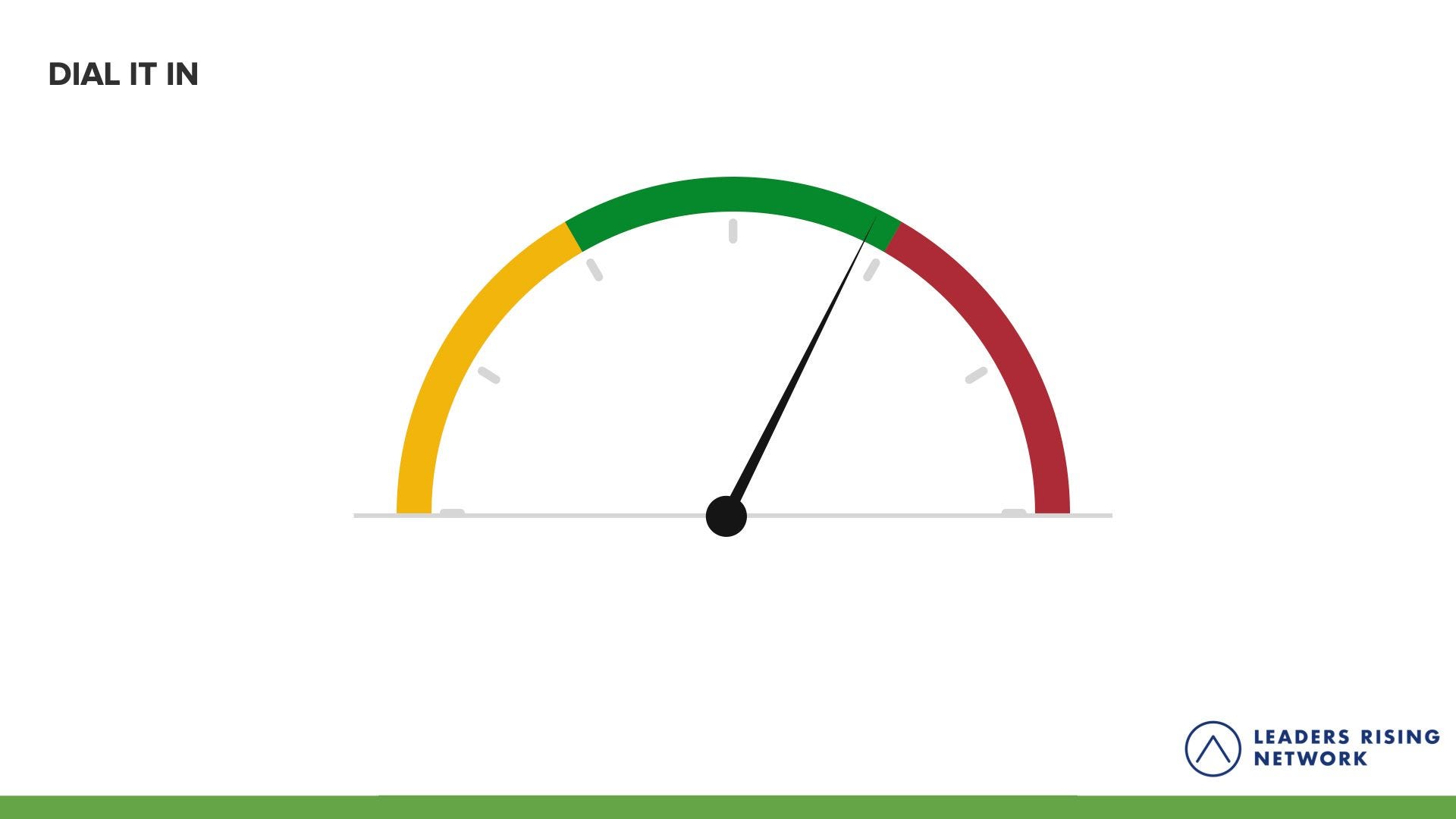
On the far left is one extreme: everyone listens to everyone else, every voice gets heard, nothing gets integrated, and nothing is ever finalized. The far right is the opposite extreme: one person directs, and no one else’s input changes the outcome.
The middle, calibrated at 90 degrees, is where great work actually happens. You hear from everyone and integrate what you heard into a shared direction. Minds change. People who came in with one position leave with a different one because someone in the room made a case that landed. That’s the dialed-in response. It’s not splitting the difference. It’s having access to the full range of the dial and choosing the right position for the moment in front of you.
Don and Val weren’t dialed in. Don was parked hard at the right — I’ll decide, we’ll remember it, we don’t need it written down. Val was parked hard at the left — everyone needs visibility, everyone needs input, nothing exists until it’s documented. Both of them had real wisdom on their side of the dial. But neither of them was reaching for the middle. Neither of them was asking where am I defaulting, and what does this moment actually need from me?
The team in the room didn’t dial it in either. They’d seen this meeting before. They’d seen what happened when someone interrupted it. They had calculated that the cost of speaking up was higher than the cost of letting another ritual play out, so they stayed silent and let the dial stay stuck.
And here is the part that makes this issue what it is: that organization wasn’t a low-trust environment. It was the opposite. The culture kept so much peace that the only way around conflict was to return to peace. Real conflict — the kind where someone makes a case that changes someone else’s mind — required a kind of trust the room had never been asked to spend. So conflict got short-circuited back to surface-level peace, every time. The dial stayed stuck. The meeting kept happening on the calendar. And everyone defaulted to Don’s position because nobody wanted to be on the wrong end of him.
Too much time goes to hot air. The talking keeps going and nothing gets decided. No minds change. No new agreements form. Nothing gets built that’s stronger or better or has more vitality. The same thing keeps happening.
Immovable, rigid, stuck.
Here is what could have changed it: one person at that table could have prompted a third way.
Not necessarily a manager intervening from above or a consultant brought in to facilitate. A team member who looked at Don and Val locked at the extremes and asked the question neither of them was asking. What if it isn’t document everything or remember everything? What if the question is what specifically needs to be written down, owned by someone, and revisited so we actually remember?
The dial moves the instant someone in the room is willing to spend the trust required to ask the third-way question. The question doesn’t need to be perfect. It needs to be asked.
It’s not either-or. It’s “what if?”
But nobody asked. Don and Val were too rooted in their own perspectives to reach for the dial themselves. Anger, indifference, frustration, annoyance — that isn’t the state a leader calibrates from. That capacity is gone before the meeting starts. So the prompt has to come from somewhere else. It has to come from the team.
This meeting had a half-dozen people who could have asked it. And yet none of them did.
You’ve been reading this from inside that team. The silent participant who saw the ritual happen, who calculated the cost of speaking up against the cost of letting it run, who chose silence and watched the dial stay stuck.
Now read the meeting again from a different seat. The seat you actually sit in.
You are a leader. You set the stage for the room. The argument that decides nothing has probably happened in your room. Maybe last week. Maybe yesterday. The people in your room make a calculation they make about whether it’s worth speaking up, and the answer they’re landing on is the outcome you keep getting from them. Maybe they’ve stopped expecting decisions from your meetings. They started doing something else with that time a long time ago.
You haven’t noticed because, from your seat, the meeting looked like a meeting.
If that’s you, it’s never too late to dial it in.
If your team stopped expecting decisions from your meetings, when did that happen, and what did they start doing instead?
