


This is Chapter 3 from Subtraction, my forthcoming book on a system for paying down your Culture Performance Debt.
This is not a book about AI.
But AI will significantly impact our ability to manage Culture Performance Debt.
AI isn’t creating new leadership problems, but it does expose your existing issues, revealing the markers of Culture Performance Debt already present in your organization.
Let’s dive into the 5 markers AI is exposing in your organization.
MARKER 1: The AI Paradox
What can AI do?
The better question is, “What can’t AI do?”
Early AI platforms won users over with the promise of fast content creation. Creative, unique style, and a strong word count. Lots and lots of words. AI is speedy at data analysis and organization, synthesizing lists, charts, and spreadsheets into well-organized documents in minutes. AI can clean up code, build an app, and design an entire website in seconds.
Sure, AI can do a lot. But as invigorating and energizing as it is to imagine what AI can do, we need to be clear about what AI can’t do. AI will never be able to touch the human, strategic, relationship-driven side of our organizations.
AI can’t lead.
If we understand this distinction, we’re already one step closer to assessing the true cost of our Culture Performance Debt.
Deciding what not to do may matter most. Deciding what NOT to do is the leader’s irreplaceable domain. AI will execute anything you point it at, with perfect efficiency and at perfect scale. That’s the problem. You can always do more. But should you?
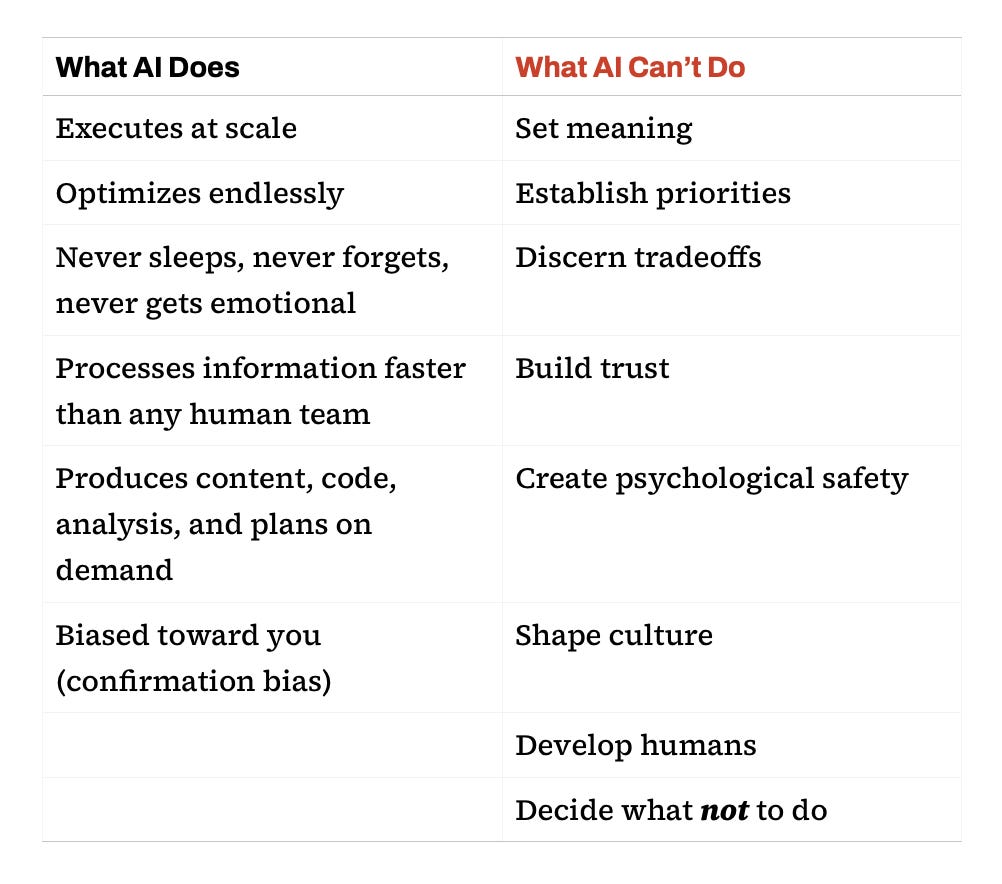
Since November 2022, AI has sped up production and output. The more capable AI becomes, the more essential human leadership becomes. Why?
Because AI amplifies everything.
Not just Culture Performance Debt. It amplifies everything, including the absence of judgment. Yes, we need more ideas. Yes, we need more innovation and expansion.
But we don’t need to build out every good idea that crosses our team members' minds. We need to prioritize, or none of them will ever be done.
MARKER 2: AI as Amplifier
AI will amplify whatever leadership already exists.
AI will not magically solve all of your company’s problems.
If your company has great leadership, add AI to your team’s capabilities, and your outcomes will increase exponentially.
If you have poor leadership, AI will only yield accelerated chaos within your organization.
— AI is going to multiply what is already true or broken. Jeff Lovell
For decades, organizations could hide behind process, bureaucracy, and incremental execution. A mediocre leader could maintain order through sheer friction, throwing roadblocks and extending timelines at every turn. Everything moved slowly enough that errors took time to spread. AI closes that gap, and speed reveals what leadership is actually aiming to do.
Take Sam, locked in on a project with extreme focus. He used AI tools to turn a fleeting idea into a full-fledged project plan, but at every step, confirmation bias nudged Sam one degree off course. Eventually, the project looked nothing like what Sam originally set out to do.
The sad part: Sam upended his life to pursue this project, severing partnerships, closing down departments, and going all in on this “incredible idea.”
The debt had stacked up, though. Sam kept pushing but ultimately wasn’t successful. What did Sam blame for the misstep? Sam pointed the finger at AI.
Yet at the core, AI only amplified what already existed: weak leadership. Sam had lost sight of the leadership compass that should have pointed this project toward a goal.
MARKER 3: The Leadership Lag
What happens when entire generations of the workforce are trained on a different model?
New models require new skills, and our current workforce is facing this challenge head-on. Production and execution are rapidly shifting to automation, but judgment calls from leaders still require a human touch.
This indicates a failure in our leadership operating system because our systems and training were not designed for this world.
The old OS was designed for:
Scarcity of information
Linear workflows
Human-only execution
Control-based trust
The digital revolution pushed the bounds of the old leadership operating system, but AI breaks every one of those assumptions. Information is now abundant, and workflows can run in parallel. Execution is no longer a human-only task, and control-based trust collapses when the team includes tools that move faster than any approval process built around a bureaucratic manager.
The systems leaders built businesses around were designed for the right environment, but that environment no longer exists. Let’s be clear: this isn’t an indictment of leaders. It’s about diagnosing the design failure so we can fix it.
Leaders in growing organizations have long felt a bottleneck in decision-making when the organization grew faster than its decision-making processes. Decisions fall on the desk of the most senior leader in the division, and that person becomes the constraint for the entire system. The leader works harder, putting in longer hours, and longs for the days when the phone does not ring.
When organizations adopt technology that speeds up production, decisions start piling up. The importance of continuous improvement is compounding.
MARKER 4: The Compounding Risk
With decisions stacking up at the leader’s desk, a new layer of risk follows closely behind.
An organization with unclear priorities and slow, poor decision-making can survive for years. The friction buys time. Slow speed creates a buffer between bad judgment and bad consequences, and enough good can outweigh risky decisions.
With AI, that buffer disappears. The same organization can now execute those same bad decisions at scale, instantly, to thousands of customers, in near real time. The cost of leadership failure becomes visible immediately. And it’s expensive.
“AI doesn’t reduce Culture Performance Debt. It amplifies the cost of carrying your debt.”
Your team can ideate on new concepts and create prototypes or demos in record time, which forces a more rapid decision: “Should we pursue this initiative right now?”
When a new idea took months to develop, leaders could make their case and either pursue it or shelve it. Then they could add critical thinking, brainstorming, and ideation to the equation. Now, new ideas can arrive every week, and every decision carries a mounting risk. Once risks start stacking, they threaten your long-term success.
MARKER 5: The Shift from Knowing to Leading
What do you go to school for? To learn.
But what do you need to learn when every answer is at your fingertips? When intelligence is abundant, leadership becomes the primary constraint.
For most of the last century, competitive advantage came from knowing the right answer. The leader who had the most information, the best analysis, and the deepest expertise won.
AI knows. It knows more than any individual, any team, any organization. The knowledge advantage is gone.
What remains is judgment: the ability to decide what matters, what to stop, what to build, and what to refuse. Education is still structured around knowing. The leaders who win in an AI-enabled world are the ones who realize judgment is now the only irreplaceable output.
“Speed without direction at scale is chaos.”
Your leaders’ top goal is setting the next waypoint for the business on your road to success. Not doing the work, but knowing where the work is leading you. A compelling vision and clear values that create guardrails for your team will point them in the right direction and set them free to deliver at peak capacity.
Because with the power of AI, your team can build almost anything. A wall ten miles long and six inches tall, or a masterpiece. Same tools. Same speed. The difference is the direction you set.
Hold that image.
_
Imagine Lance at Tackmo Corporation, working through the Culture Performance Debt the company has built up. Lance’s new COO, Leena, starts testing AI tools to boost productivity. Instead of improving the situation, the pace accelerates, but production lags, and customers complain about longer delivery times.
Leena is busier than ever, but the company hasn’t become more efficient. Lance and Leena have a dozen new initiatives that could save the company, but one problem remains: they’re the ones driving every initiative.
Weekends never feel refreshing, and the workdays get longer and longer with each mounting project on the board. Lance is exhausted. So is Leena.
Across town at Camco, Rita started exploring advanced AI tools, too. With her team’s help, each person tested, innovated, and integrated tools into their existing systems.
Rita pulls the executive team together one Friday morning to discuss the rollout of their Q2 initiative. “Where do we stand?” Marketing and the VP of Sales report that the project is on schedule, and the new products will be on the market as soon as the next round of deliveries wraps up.
“Incredible work, team,” Rita wraps up. “Enjoy your weekend knowing the last 45 days have proven the strength of our team!”
Unlike Tackmo, Rita pushed the team to focus their energy and workload. Instead of Rita owning a dozen initiatives, the team pitched in to rapidly implement a single major project. AI enabled rapid development, pressure testing, and daily assimilation of market test data into actionable insights.
At Camco, the focus on delivery and completion meant they minimized the debt that stacked up.
_
Over the course of my career, I can recall a few specific moments when I got it wrong. At the time, I thought I was 100% right. One specific visual: walking into my boss’s office with yet another “great” idea. I pitched the concept: “Wouldn’t it be amazing to use this new technology to build this asset?”
And it never happened. Most of my “great ideas” didn’t happen — and that was before AI. Imagine how many “amazing” ideas I could generate with these tools at my fingertips!
Fast-forward to today, and I do have those tools. I also have a clear vision of where the business is headed, and I constantly prioritize initiatives and ideas, pressure-test them for fit within our business model, and focus on what matters most.
The latest great idea may be great, but I constantly have to remind myself I don’t have to work on it today. That great idea might not come to life until Q3 of next year, if at all.
Because I’m working to build a masterpiece, not a wall ten miles long and six inches tall.
Now that you can see Culture Performance Debt clearly, you can see how it leaks your productivity on your quest for world-changing work. Don’t fall through the trap door and get lost on this pathway. You can’t solve every piece of debt at once, but you can fix one at a time.
The question isn’t whether you’re carrying Culture Performance Debt. The question is where. That’s what we’re going to find out next.